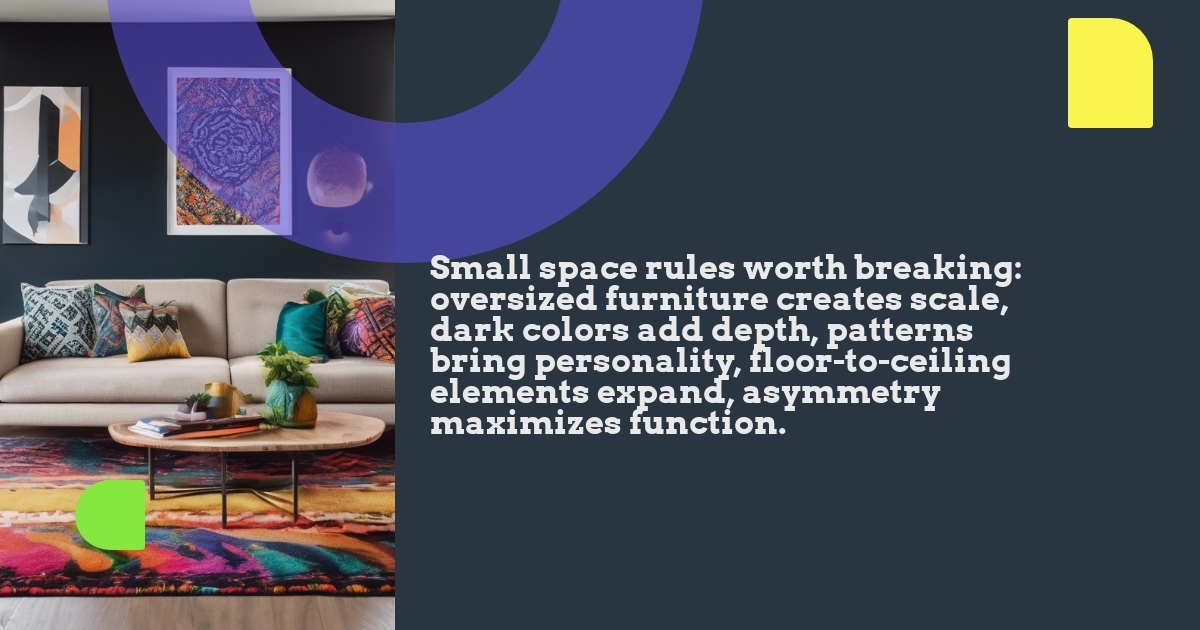
Have you ever wondered why some tiny apartments in magazine spreads look surprisingly spacious while your carefully-followed small space rules still leave your home feeling cramped? The secret might not be what you’re doing, but rather what you’re afraid to do. Professional interior designers regularly toss out the conventional small-space rulebook—and achieve remarkable results by embracing approaches that initially seem counterintuitive.
When it comes to small space decorating tips, we’ve all heard the standard advice: stick to light colors, use small furniture, avoid patterns, and keep everything minimal. But what if these widely accepted rules are actually limiting your space’s potential?
Let’s explore five conventional design rules that top interior designers intentionally break—and why you might want to join the rebellion.
Rule 1: Avoid Oversized Furniture in Small Spaces
The common wisdom suggests filling small rooms with small-scale furniture to maximize floor space. Surprisingly, professional designers often do the exact opposite.
Why designers break it: A few thoughtfully selected larger pieces can actually make a room feel more spacious than several small pieces. When you crowd a room with multiple small furniture items, you create visual clutter that makes the space feel busy and confined.
How to break it right:
- Choose one statement piece like a comfortable full-sized sofa instead of a loveseat and chair
- Opt for fewer, larger pieces rather than many small ones
- Ensure proper circulation space around your larger furniture
- Select pieces with legs that allow visibility underneath, creating a sense of airiness
Interior designer Sarah Johnson explains, “A generously sized sofa with clean lines anchors a small living room and creates a sense of intentional luxury rather than compromise. The key is choosing pieces that have the right proportions and visual weight.”
Rule 2: Always Use Light Colors to Make Spaces Feel Bigger
We’ve all heard it: paint small spaces white or light colors to make them feel bigger and brighter. While light colors can work beautifully, limiting yourself to pale hues isn’t always the best approach.
Why designers break it: Dark colors can create depth and dimension in small spaces, making walls visually recede rather than close in. Deep colors add sophistication and can transform a cramped room into a cozy, intimate sanctuary.
How to break it right:
- Consider navy, charcoal, forest green, or deep burgundy for an accent wall or entire room
- Balance dark walls with adequate lighting (both natural and artificial)
- Incorporate reflective surfaces like mirrors or metallic accents to bounce light
- Use contrasting lighter elements for visual relief
“Dark colors create shadow and depth perception, which can actually enhance spatial awareness,” notes color psychologist Dr. Rebecca Chen. “A small room in all white can feel like a bland box, while the same room in a rich, deep color develops character and dimension.”
Rule 3: Avoid Patterns in Small Spaces
Conventional small apartment design tricks often suggest sticking to solid colors to prevent visual overwhelm. Patterns, we’re told, make spaces feel busier and therefore smaller.
Why designers break it: Strategic pattern mixing creates visual interest, depth, and personality in compact spaces. The right patterns can draw the eye where you want it to go and establish a strong sense of identity that transforms a small space from forgettable to remarkable.
How to break it right:
- Mix scale: Combine larger patterns with smaller, more delicate ones
- Maintain a consistent color palette throughout your patterns
- Use patterns strategically—perhaps on a feature wall, curtains, or key upholstery
- Balance busier patterns with solid-colored elements
Designer Miguel Fernandez points out, “Pattern creates a visual journey in small spaces. Rather than making a room feel smaller, it gives the eye places to travel, creating the perception of a more expansive environment.”
Rule 4: Keep Window Treatments Minimal and Walls Empty
We’re often advised to keep window treatments sparse and avoid overwhelming small walls with art or decor to maximize small spaces.
Why designers break it: Floor-to-ceiling curtains create vertical lines that visually extend your ceiling height. Similarly, a thoughtfully arranged gallery wall or large-scale art can create a focal point that draws attention away from the room’s size limitations.
How to break it right:
- Hang curtains from ceiling to floor, even if your windows are smaller
- Mount curtain rods close to the ceiling and extend them beyond window frames
- Don’t be afraid of statement art pieces that take up significant wall space
- Consider a gallery wall that creates a cohesive visual statement
“When you hang curtains at the proper height and width, you’re essentially creating an illusion that your windows—and therefore your walls—are larger than they actually are,” explains interior stylist Lisa Mendoza. “This simple trick can make ceiling heights appear up to a foot taller.”
Rule 5: Keep Everything Symmetrical and Centered
Conventional interior design rules for small spaces often emphasize symmetry and centered arrangements to create order and balance.
Why designers break it: Asymmetrical arrangements can be more space-efficient and functional for how you actually use your rooms. They create visual interest and can make spaces feel more dynamic and thoughtfully curated rather than formulaic.
How to break it right:
- Focus on visual balance rather than perfect symmetry
- Arrange furniture based on traffic flow and actual use patterns
- Create conversation areas that maximize your available space
- Use angle placement to activate dead corners
“In small spaces, functionality should lead design decisions,” says interior architect James Wilson. “An asymmetrical furniture arrangement often allows for better traffic flow and more usable space than forcing everything into symmetrical pairs.”
Why These Rule-Breaking Approaches Work
These contrarian approaches succeed because they embrace design psychology principles that go beyond simple spatial measurements:
- They create focal points that direct attention away from size limitations
- They add personality that makes spaces memorable rather than merely functional
- They use visual tricks that manipulate perception of depth, height, and dimension
- They prioritize how spaces feel rather than just how they measure
Getting Started: Small Steps Toward Breaking the Rules
Not ready to paint your entire apartment navy blue or invest in an oversized sectional? Start small:
- Add a dark accent wall in a bathroom or bedroom
- Introduce one large statement piece while removing several smaller items
- Experiment with patterned throw pillows or a bold area rug
- Rehang your curtains higher and wider than your window frames
- Try rearranging furniture at angles rather than parallel to walls
Remember that the most successful small home design hacks come from understanding principles, not just following rules. When you grasp why these contrarian approaches work, you can adapt them to your unique space.
The Bottom Line: Design Confidence Makes Small Spaces Shine
The real professional design secret might be simpler than we think: confidence. Small spaces don’t need to be apologetic or play it safe. By breaking these conventional rules thoughtfully, you transform limitations into distinctive design opportunities.
Your compact home doesn’t need to follow every guideline in the small-space design manual. Sometimes, the most effective approach is breaking the very rules you’ve been carefully following.
Which design rule are you most excited to break in your small space? Have you already experienced success with any of these contrarian approaches? Share your experiences and questions in the comments below!
Leave a Reply